





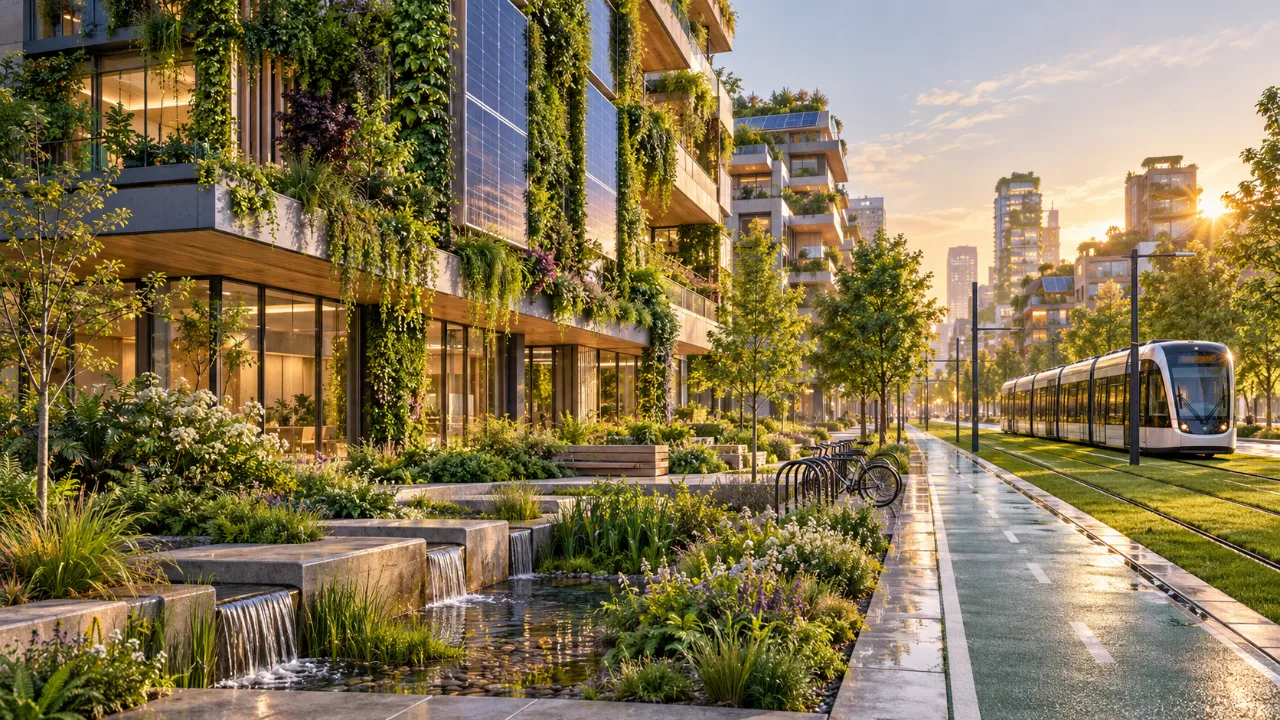
What Are Sustainable Cities and How Do They Work?
When people ask what sustainable cities are, the answer comes down to balancing three dimensions: environmental, social, and economic. A city of this kind reduces its ecological footprint, ensures decent living conditions, and maintains a stable economy over the long term. This principle is enshrined in Sustainable Development Goal 11 of the United Nations 2030 Agenda, which is dedicated to sustainable cities and communities.
- Efficient mobility. Public transport, bike lanes, and pedestrian zones reduce dependence on cars.
- Clean energy. Renewable sources and well-insulated buildings cut emissions.
- Resource management. Recycling, material reuse, and responsible water use prevent waste.
- Green spaces. Parks and trees improve air quality and help regulate temperatures.
- Social inclusion. Affordable housing and local services strengthen cohesion between neighborhoods.
- Responsible digital services. Online platforms, from public services to new online casinos, can reduce the impact of their data centers by using renewable energy.
None of these measures solves the problem on its own. It is the combination of them that makes a city sustainable.
Examples of Sustainable Cities on Different Continents
Several urban centers have turned these principles into concrete policies. The following examples of sustainable cities show different approaches, each adapted to its regional context.
Copenhagen and Bicycle Mobility
The Danish capital is known for its strong cycling culture. An extensive network of bike lanes, separated from car traffic, makes cycling a safe and practical option for everyday commuting. The city pairs this commitment with ambitious emissions-reduction targets and the use of wind power.
Curitiba and Innovative Public Transport
Curitiba, in Brazil, pioneered a bus system with dedicated lanes and rapid-boarding stations that was later adopted in other countries. Together with an extensive network of parks and recycling programs, this system places it among the sustainable cities that serve as a model for other municipalities.
Singapore and Nature Woven into the City
Singapore shows that a dense city can integrate nature into its urban fabric. Vertical gardens, green roofs, and ecological corridors link parks to residential areas. The city-state also invests in water recycling and rainwater harvesting to reduce its reliance on external sources.
Lisbon and Its Recognition as European Green Capital
In 2020, Lisbon was named European Green Capital by the European Commission, becoming the first capital in Southern Europe to receive this distinction. The award recognized the expansion of green spaces, active mobility, and efficient water use. The case confirms that sustainable cities in Portugal follow principles shared with other regions.
The models vary, but the logic remains the same: plan urban space so that people can live better without depleting resources. Sustainable cities are not the result of a single measure, nor are they completed within a set timeframe. They depend on consistent political decisions, ongoing investment, and the participation of the people who live in them.

Rubén Sáez
Author at Waste 4think

Adrián Montalvo
Editor at Waste 4think